Ultrasonic vs. Evaporative Humidifiers: White Dust, Water Type, and Cleaning
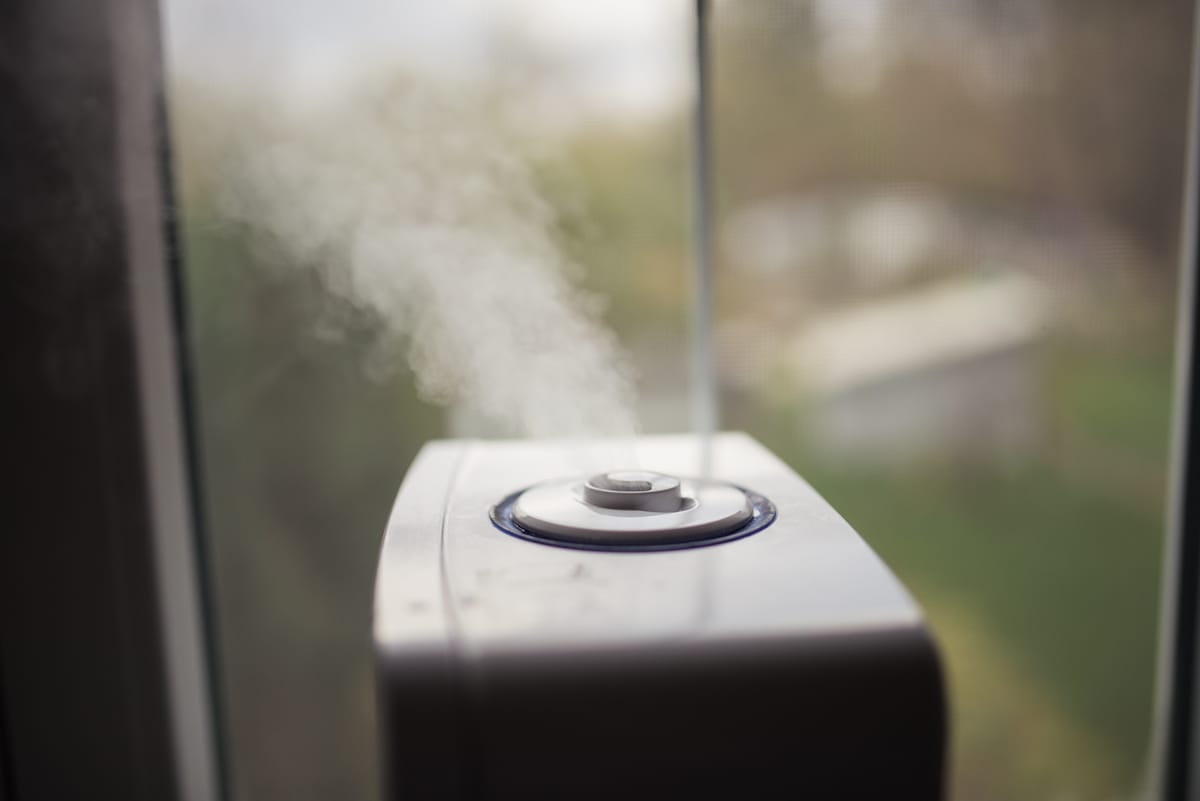
Ultrasonic humidifiers are quiet and energy-efficient, but they launch dissolved minerals and any bacteria in the tank straight into the air—causing the powdery "white dust" that settles on furniture and spikes indoor fine particles. Evaporative and steam (warm-mist) humidifiers turn water into vapor instead, leaving minerals behind in the filter or boiling chamber. If you want to use regular tap water with lower airborne-particle risk, choose an evaporative or steam model; if you already own an ultrasonic unit, run it on distilled water and clean the tank every three days.
How do ultrasonic, evaporative, and steam humidifiers differ?
The core difference is whether the machine launches liquid droplets or releases water vapor. The US EPA's guide to home humidifiers groups portable models by how they disperse moisture and how much material from the tank ends up in your air:
| Type | How it works | White dust / mineral dispersal | Microorganism dispersal | Main trade-off |
|---|---|---|---|---|
| Ultrasonic | High-frequency vibrations break liquid water into a visible cool mist | High with tap water | High if the tank isn't kept clean | Quiet and cheap to run, but needs distilled water and strict cleaning |
| Impeller (cool mist) | High-speed rotating disk flings water into fine droplets | High with tap water | High if the tank isn't kept clean | Similar airborne dispersal issues to ultrasonic units |
| Evaporative | Fan blows air through a wet wick, belt, or filter (invisible vapor) | Minimal to none | Minimal to none | Fan noise and replacement wick filters; still grows mold if left wet |
| Steam vaporizer (warm mist) | Heating element boils water into steam (cooled slightly in warm-mist units) | Minimal to none | Minimal to none | Higher electricity use, mineral scale inside the tank, and burn risk around children |
Because evaporative humidifiers rely on natural evaporation, they also self-regulate somewhat as room humidity rises. Ultrasonic units keep pumping mist into the room regardless of humidity unless they have a working humidistat, which makes it easier to over-humidify a bedroom.
What causes humidifier white dust, and is it harmful?
White dust is dried tap-water minerals—mostly calcium and magnesium—that were dissolved in your water tank and left floating in the air once the mist droplets evaporated. Because an ultrasonic transducer breaks water mechanically rather than boiling or evaporating it, everything dissolved in the water rides out inside the droplets.
Peer-reviewed measurements show how sharply water type changes indoor air quality. A 2020 study in Environment International (PMID 32623220) ran an ultrasonic humidifier with four different water types and measured airborne total mineral solids:
| Fill water used in ultrasonic unit | Median particle size | Particle count | Airborne mineral concentration |
|---|---|---|---|
| Deionized water | 64 nm | 2,194 /cm³ | 16 µg/m³ |
| Low-mineral tap water | 129 nm | 21,070 /cm³ | 113 µg/m³ |
| High-TDS, high-hardness tap water | 234 nm | 38,353 /cm³ | 438 µg/m³ |
| High-TDS, low-hardness (softened) water | 260 nm | 43,880 /cm³ | 521 µg/m³ |
Every tap-water sample pushed indoor particle concentrations well above ambient fine-particle standards, and softened water performed slightly worse than hard tap water because water softeners swap calcium and magnesium for sodium rather than removing dissolved solids.
A companion Virginia Tech study in Water Research X (PMID 32793876) found that tap-water mist dried into submicron particles (median 146 nm, mean 211 µg/m³ in a 33.5 m³ room). About 90% of particles modeled to deposit in human lungs were smaller than 1 µm, and per unit of body weight, modeled 8-hour lung deposition was 3.5 times higher in children (9.8 µg/kg) than in adults (2.8 µg/kg). The EPA notes that while the full health impact of breathing mineral dust is still being studied, young children, older adults, and people with asthma or lung conditions are the most sensitive—and reducing exposure with low-mineral water is the prudent move.
Should you use tap water or distilled water in a humidifier?
The answer depends on the type of humidifier you use.
- For ultrasonic and impeller humidifiers, use distilled or demineralized water. The EPA explicitly advises choosing bottled water labeled "distilled" rather than "spring," "artesian," or "mineral" water, which still contain dissolved minerals. Even if white dust doesn't bother you, tap-water minerals build crusty scale inside the tank that gives bacteria and mold a surface to cling to.
- For evaporative and steam humidifiers, regular tap water is usually fine. Minerals stay trapped in the wick filter or settle as scale in the boiling chamber instead of entering the air. You'll just need to descale a steam unit or replace evaporative wicks on schedule.
- Don't rely on pitcher filters or home water softeners to fix white dust. Carbon pitchers remove chlorine and taste compounds without removing most dissolved minerals, and ion-exchange softeners replace hardness minerals with sodium—which still dries into airborne dust. Demineralization cartridges sold for humidifiers vary widely in performance, so the EPA recommends watching for white dust as a sign a cartridge isn't keeping up.
How often should you clean a humidifier to prevent bacteria and mold?
Standing water in a warm room grows biofilm and microbes quickly, regardless of the water you put in. The EPA's cleaning schedule breaks down into three habits:
- Empty, wipe dry, and refill daily. Unplug portable units, dump leftover water rather than topping it off, wipe the tank surfaces dry, and fill with fresh water.
- Scrub and disinfect every third day. Use a brush or soft scrubber to remove scale and slimy film from all interior surfaces. Follow the maker's instructions on cleaners; if none are given, the EPA recommends a 3% hydrogen peroxide solution, followed by rinsing thoroughly with several changes of tap water so no chemical residue becomes airborne.
- Dry completely before storage and replace consumables. At the end of winter—or any time the unit sits idle for days—empty and dry every part, discard used wicks or demineralization cartridges, and clean the unit again before using it next season.
Also avoid adding essential oils or unauthorized chemical additives to standard water tanks; they aren't meant to be aerosolized into lungs and can damage plastic components.
What indoor humidity level should you aim for in winter?
Keep indoor relative humidity between 30% and 50%, and don't let it climb above 50%. The US EPA's indoor air quality guide warns that humidity over 50% encourages mold and dust mites, and advises turning a humidifier down or moving it whenever moisture condenses on windows, walls, or surrounding fabrics.
In deep winter, the right setting is a balancing act. Running too dry brings on dry skin and worse winter static shocks, while pushing humidity too high against freezing glass causes winter window condensation and windowsill mold. A standalone digital hygrometer placed across the room from the humidifier gives a much more accurate reading than the sensor built into the machine itself.
Image: Shixart1985, CC BY 2.0, via Wikimedia Commons