Why Your Tire Pressure Warning Light Turns On in Cold Weather
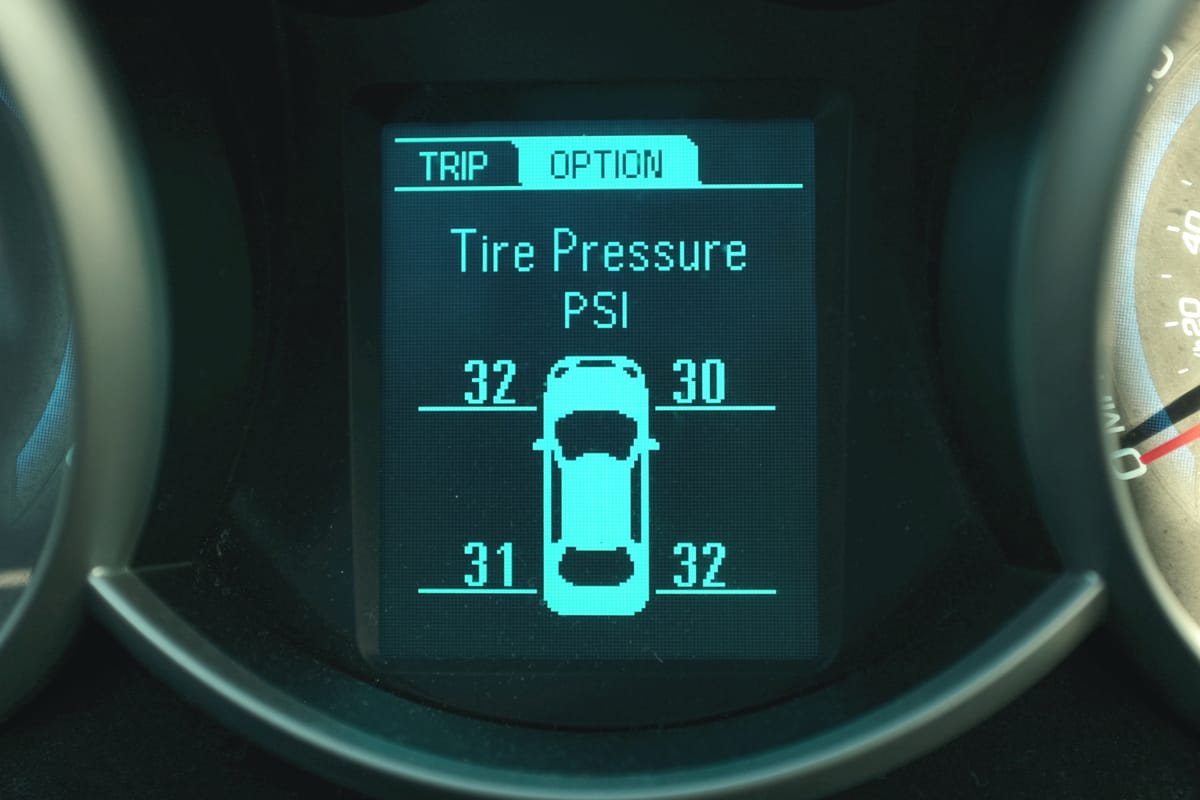
Your tire pressure warning light (TPMS) turns on during the first cold snap because air inside a tire contracts as temperatures fall, dropping pressure by about 1 PSI for every 10°F (roughly 1.8 PSI per 10°C) decline. Even if the light switches off after 10 or 15 minutes of driving, your tires are still under-inflated when cold—the warning only cleared temporarily because road friction warmed the air back up. The fix is to check and top up your tires when cold to the exact PSI printed on your driver's door-jamb sticker, not the number on the tire sidewall.
How much does tire pressure drop in cold weather?
Tire pressure falls roughly 1 PSI for every 10°F drop in ambient temperature—about 1.8 PSI (12 kPa) for every 10°C drop—according to AAA Club Alliance and Bridgestone Americas. Tires also naturally lose around 1 PSI per month through gradual air permeation even without a nail or leak.
Put those two together across a seasonal swing, and the drop adds up quickly:
| Last inflated at 70°F (21°C) | Cold morning at 30°F (−1°C) | Cold morning at 10°F (−12°C) |
|---|---|---|
| 35 PSI (recommended) | ~31 PSI (−4 PSI) | ~29 PSI (−6 PSI) |
| 32 PSI (already 3 PSI low) | ~28 PSI (−4 PSI) | ~26 PSI (−6 PSI) |
Under U.S. Federal Motor Vehicle Safety Standard No. 138 (49 CFR § 571.138), a vehicle's TPMS must illuminate the low-pressure warning light within 20 minutes once any tire drops 25% or more below the manufacturer's recommended cold inflation pressure. For a car spec'd at 35 PSI, 25% below is 26.25 PSI—which is why a tire that was already a few PSI low in October crosses the threshold overnight on the first freezing morning.
Why does the TPMS light turn off after driving for a few minutes?
Because rolling and flexing heats the rubber and warms the air trapped inside the tire, causing pressure to rise by a few PSI—often just enough to push a borderline tire back above the TPMS trigger point.
That doesn't mean the problem fixed itself. Once the car sits parked again, the air cools and pressure falls right back below spec. A warning light that glows on cold mornings and vanishes mid-commute is a classic sign that your cold pressure is sitting near the bottom edge of safe inflation and needs air, not a sensor glitch.
Watch the behavior of the icon too:
- Steady solid light: One or more tires are significantly under-inflated. Inspect for a nail or visibly flat tire, then check all four tires (plus the spare if equipped) with a gauge.
- Flashing light for about a minute, then solid: Under FMVSS 138, a flashing telltale signals a TPMS system malfunction—commonly a dead wheel sensor battery (which typically lasts several years) or a damaged sensor—rather than a confirmed pressure drop, though you should still check the tires manually with a gauge.
Does under-inflated winter tire pressure hurt safety and gas mileage?
Yes, both. Under-inflated tires flex more at the sidewalls, generate excess heat at highway speed, wear out faster along the outer shoulders, and reduce steering precision and wet or slushy grip. Transport Canada also notes that below 7°C (45°F), summer and all-season rubber compounds begin losing elasticity, so under-inflation compounds an already lower winter traction margin.
Fuel economy takes a measurable hit too. The U.S. Department of Energy and EPA report on FuelEconomy.gov that keeping tires properly inflated improves gas mileage by 0.6% on average—and up to 3% in some cases—while under-inflated tires cut fuel economy by roughly 0.2% for every 1 PSI drop in the average pressure of all four tires. On FuelEconomy.gov's cold-weather page, lower tire pressure and higher rolling resistance are listed alongside denser cold air and winter fuel blends as direct reasons winter MPG falls.
How should you check and fill tire pressure in winter?
Following four basic rules avoids both under-inflation and inaccurate readings:
- Read the door-jamb sticker, not the tire sidewall. FuelEconomy.gov emphasizes that your vehicle's recommended cold pressure is printed on the placard inside the driver's door jamb (or in the glove box or owner's manual). The number molded onto the tire sidewall is the tire's maximum safe limit, not the target for your car.
- Measure when the tires are cold. Bridgestone defines "cold" as a vehicle parked for at least 3 hours (or driven less than a mile). Measuring right after a highway commute reads high and leads you to under-fill.
- Account for a heated garage. Transport Canada warns that a tire inflated to exact spec inside a warm garage will be under-inflated once you drive out into sub-freezing air. Check outside in winter air if you can—or if you must fill in a heated bay, re-check once the car has cooled outdoors.
- Watch for one tire dropping faster than the others. Cold weather affects all four tires together. If three tires dropped 3 PSI and one tire dropped 10 PSI, suspect a slow puncture or leaking valve stem rather than temperature alone.
Cold weather catches drivers and everyday tech off guard in similar ways—see why phone batteries drain faster in the cold and why static shocks get worse in winter (including the gas-pump static safety rule).
Image: WillisMoon, CC BY 4.0, via Wikimedia Commons