Why Does My Phone Battery Die So Fast in the Cold?
Your phone dies early in the cold because low temperatures slow the chemistry inside its lithium-ion battery, so it can't deliver power as easily and the voltage sags. The good news: the lost capacity comes back once the phone warms up. The one thing that can cause lasting damage is charging the battery while it is still freezing cold, so let the phone warm up before you plug it in.
What temperature is too cold for a smartphone?
Anything below 0°C (32°F) is outside the range phone makers design for. Both Apple and Samsung publish the same window for normal use, and Apple adds a wider range for when the phone is just being stored.
| Apple (iPhone) | Samsung (Galaxy) | |
|---|---|---|
| Normal use | 0–35°C (32–95°F) | 0–35°C |
| Storage (switched off or idle) | -20–45°C (-4–113°F) | Avoid below-zero storage |
| Ideal comfort zone | 16–22°C (62–72°F) | — |
Sources: Apple Support, Apple battery guide, Samsung battery care.
So a phone left in a coat pocket on a -5°C morning is fine, but one sitting in your hand or on a ski lift for an hour at that temperature is working outside its rated range.
Why does cold weather drain a phone battery faster?
Cold makes it harder for the battery to push current out, not easier for the charge to leak away. A lithium-ion cell works by moving lithium ions through a liquid electrolyte between two electrodes. As the temperature falls, that movement slows and the cell's internal resistance rises. Battery University notes that this higher resistance noticeably hurts discharge performance in the cold.
Higher resistance means the voltage drops further every time the phone asks for power, like when the screen lights up, the camera opens or the radio searches for signal. The phone's battery gauge reads that lower voltage as a lower charge level. That is why the percentage can fall in visible jumps outdoors, even though most of the energy is still in the cell.
Why does my phone shut off at 20% or 30% in the cold?
It shuts off to protect itself when the voltage sags below a safe level, even if the gauge still shows charge left. Apple says that using an iPhone in very cold conditions outside its operating range can temporarily shorten battery life and "could cause your device to turn off."
An older battery is more likely to do this. A worn cell already has higher internal resistance, so the extra resistance from the cold pushes it over the edge sooner. If your phone only does this in winter, the cold is the main cause. If it also happens at room temperature, the battery itself is probably due for replacement.
Is the battery capacity lost in the cold permanent?
No, ordinary cold use does not permanently reduce capacity. Apple's battery guide says the drop in battery life in a very cold environment is temporary, and that performance returns to normal once the battery is back in its normal temperature range. Heat is the opposite: Apple warns that temperatures above 35°C can permanently damage battery capacity.
Lab research points the same way. In a 2025 study in Thermal Science and Engineering Progress, researchers cycled pouch cells 100 times at 25°C, 0°C and -20°C. The cells cycled at -20°C lost a lot of capacity during the test, but most of it came back after they were warmed to 25°C. The same study found that 0°C was actually the harsher point, causing the most lithium deposits and permanent wear. That was repeated charging and discharging in a lab, not a phone in your pocket, but it shows why the next point matters.
Is it bad to charge a cold phone?
Yes, charging a battery that is below freezing is the one cold-weather habit that can do lasting damage. Battery University lists 0–45°C as the acceptable charging range for lithium-ion and explains that charging below freezing plates metallic lithium onto the anode, which permanently reduces performance and safety. It also notes the battery may look like it charged normally, so you won't notice the harm.
Phones guard against this. Apple says a too-cold iPhone "might not charge or could stop charging," and you may see a Charging On Hold message on the Lock Screen. Samsung says its devices limit charging when the temperature is outside a set range. Still, the battery inside a phone that just came in from the cold can be colder than the room, so it's worth giving it time.
How do you keep your phone battery alive in winter?
Keep the battery near body temperature and let it warm up gently before charging. In practice:
- Carry it in an inside pocket, close to your body, instead of an outer pocket, a bag or a car mount.
- Use it in short bursts outdoors. Long camera or navigation sessions in sub-zero air are what drain it fastest.
- Turn on Low Power Mode or Power Saving before a long day outside so the phone draws less current.
- Don't leave it in a parked car overnight. Apple specifically warns that car temperatures can go beyond the storage range.
- If it shuts off, warm it up before restarting it. Put it back in your pocket or bring it indoors. The charge usually reappears once it warms.
- Wait before charging. Let a cold phone sit at room temperature for a while (Samsung says to let it return to 0–35°C before use) before plugging it in.
- Don't use a heater or hair dryer to speed things up. Overheating causes the permanent damage that cold doesn't.
If you want the battery to last for years, heat and high charge levels matter more than winter mornings. We cover that in whether an 80% charge limit is worth it and what keeping a laptop plugged in does to its battery.
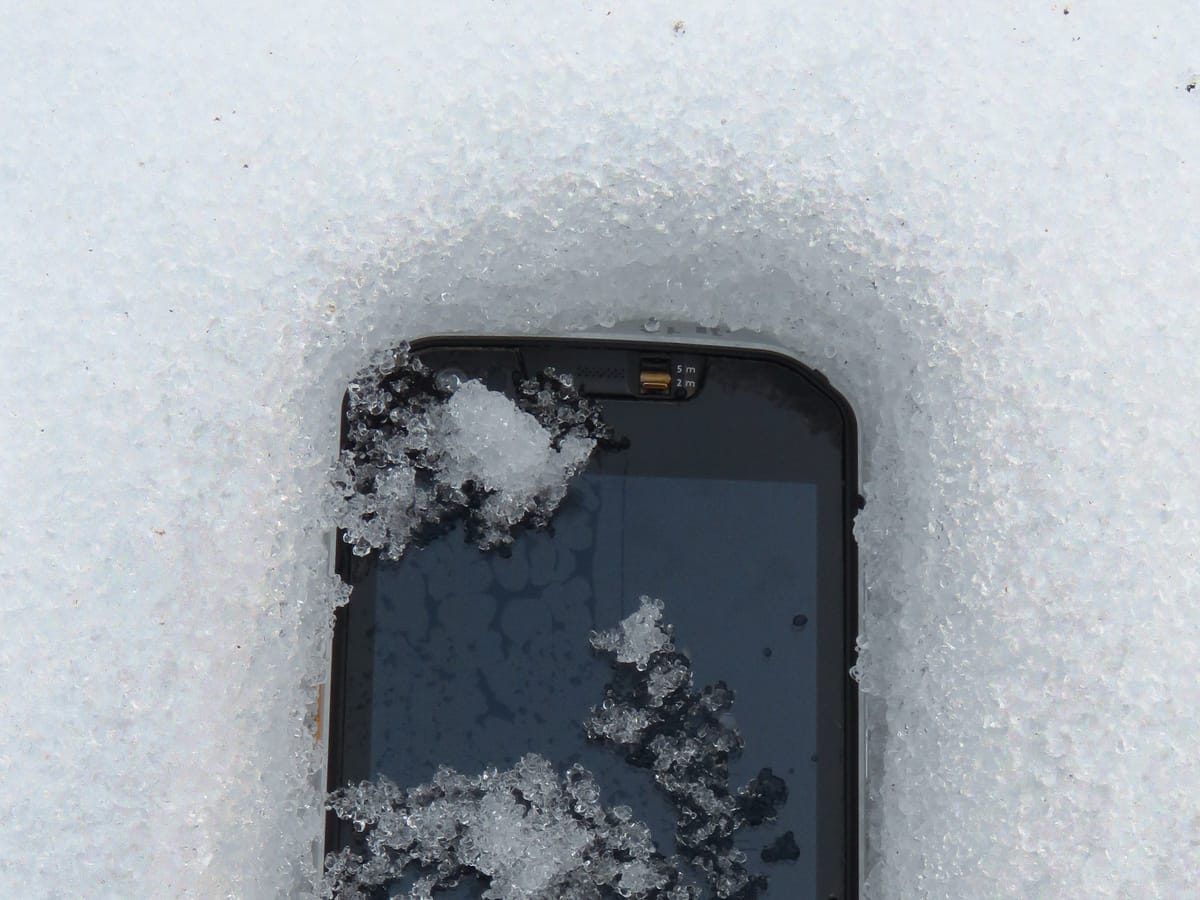
Featured image: Crispin Cooper (Prosthetic Head), S60 in Snow, CC BY-SA 4.0, Wikimedia Commons (cropped)