The Truth About Smart Scales vs. DEXA Scans: What Each One Really Measures
- Health, Technology, Review
- Exienent
- · Updated
Cheap bioelectrical impedance (BIA) smart scales are not accurate enough to trust their absolute body fat number, because the reading swings with hydration and the current never reaches your upper body. DEXA (Dual-energy X-ray absorptiometry) scans are the medical gold standard. A smart scale can still be useful, but mainly for watching the trend over weeks and months, not for the exact percentage.
What Does a Cheap Smart Scale Claim to Measure?
A budget "smart scale" can promise far more than weight: body fat percentage, muscle mass, bone density, and even a "metabolic age." The charts in the companion app are satisfying to watch go up and down every morning.
The catch shows up in odd patterns. A big glass of water right before stepping on the scale can make body fat appear to drop. A salty meal the night before can make it look like you suddenly gained muscle. Those swings are a clue that the scale is largely estimating from how much water your body is holding.
How Does Bioelectrical Impedance Actually Work (Or Not)?
A BIA scale sends a tiny electrical current through your legs and estimates body fat from the resistance. Your smart scale doesn't have x-ray vision. When you step on those metal plates barefoot, the scale sends an unnoticeable current up one leg, across your pelvis, and down the other leg.
Electricity flows easily through water (muscle is about 75% water). It struggles to flow through fat (which has very little water). By measuring the resistance—the impedance—the scale calculates how much water is in your lower body, plugs that into an algorithm with your height, weight, age, and gender, and spits out a body fat percentage.
The problem? Hydration ruins everything.
If you are dehydrated, your electrical resistance goes up, and the scale thinks you are fatter than you are. If you are super hydrated, the resistance goes down, and you suddenly look shredded on the app. Furthermore, the current only goes up to your waist and back down. If you carry more fat in your upper body, the scale literally cannot "see" it. It's just extrapolating based on averages.
How Is a DEXA Scan Different?
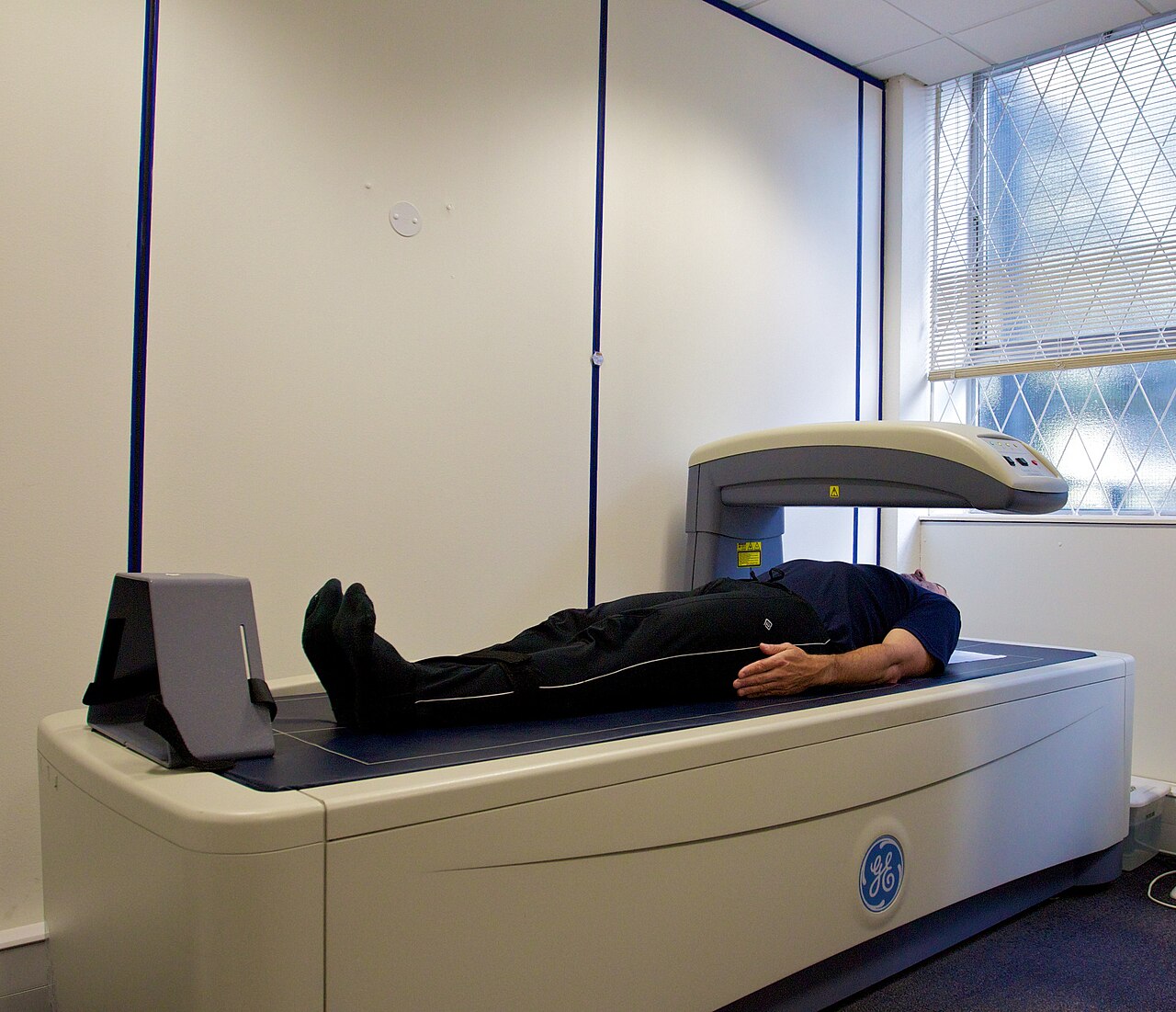
A DEXA scan measures tissue density across your whole body instead of estimating from leg impedance. You lie on a flat bed while a mechanical arm slowly passes over your entire body, using very low-dose x-rays to measure tissue density. It maps exactly where your fat is, where your muscle is, and how dense your bones are.
That difference matters most for people whose fat is distributed unevenly. Someone who carries less fat in the legs (which the scale measures) and more around the midsection (which it can only guess at) may get a smart scale reading that is noticeably lower than their DEXA result. In that case, the scale is flattering you, not measuring you.
Are Smart Scales Useless for Tracking Body Fat?
Not exactly. Because a given scale applies the same method and the same algorithm every time, it can still show the direction of change even when its absolute number is off.
If you combine a modest caloric deficit with consistent training, a smart scale's trend line may move in the same direction as a DEXA scan's, even if the two disagree on the actual percentage. The absolute numbers on a smart scale can be wrong while the trend is still informative. Periodic DEXA scans are the way to check whether that trend is lining up with reality.
How Should You Actually Use a Smart Scale?
If you are buying a cheap smart scale expecting medical-grade accuracy, you are going to be disappointed. However, if you treat the numbers as abstract "points" rather than absolute facts, they can be a useful tool for tracking progress.
- Don't rely on the absolute body fat number. It may well be wrong. If you really need to know your exact body fat percentage, pay $70-$100 for a DEXA scan.
- Focus on the trend line over weeks and months. A downward trend may suggest you are losing fat; a DEXA scan can confirm it.
- Weigh yourself under identical conditions. For example, first thing in the morning, after using the bathroom, and before drinking any water. This minimizes the hydration variables that confuse the BIA sensors.
- Take the "Muscle Mass" and "Bone Density" metrics with a huge grain of salt. They fluctuate wildly based on water weight and are the least accurate parts of the algorithm.
A smart scale can be a great motivational tool, just don't let it gaslight you into thinking you gained two pounds of fat overnight because you ate some salty ramen. If you have specific health or body composition goals, a doctor or registered dietitian can help you interpret the numbers. Use the data to guide your habits, not to define your self-worth.