Room-Scale Wireless Power in 2026: Does It Really Feel Like Magic?
- Hardware
- Exienent
- · Updated
True room-scale wireless power is finally arriving in 2026, and in a home office it can make devices feel like they have near-infinite battery life. A ceiling-mounted RF transmitter can keep phones, tablets, peripherals and small sensors topped up from across the room—but charging is slow, works best with line of sight, and devices without a built-in receiver chip still need add-on receivers.
We've been hearing about "true wireless power" for over a decade. Ever since the early days of Qi charging pads, tech companies have promised a future where our devices just magically charge while sitting in our pockets or resting on a table. But for the longest time, "wireless charging" just meant plugging a pad into a wall and then carefully aligning your phone on it. It wasn't wireless; it was just a different kind of wire. Newly released room-scale RF (Radio Frequency) transmitters are the first products that genuinely change that.
What is Room-Scale Wireless Power?
Room-scale wireless power is not an inductive charging pad or even a short-range magnetic resonant charger.
Room-scale wireless power uses focused radio frequency (RF) waves or near-infrared light beams to safely transmit power to devices over distances of 10 to 15 feet. A central transmitter—usually mounted on the ceiling or high on a wall like a Wi-Fi router—scans the room for authorized receivers. When it detects a compatible device with an embedded receiver chip, it directs a narrow, focused beam of energy to that device, continuously charging its battery as long as it's in the line of sight or within the reflection path.
The short answer to how it feels? It can feel like your devices suddenly have infinite battery life.
What Is It Like to Live Cable-Free?
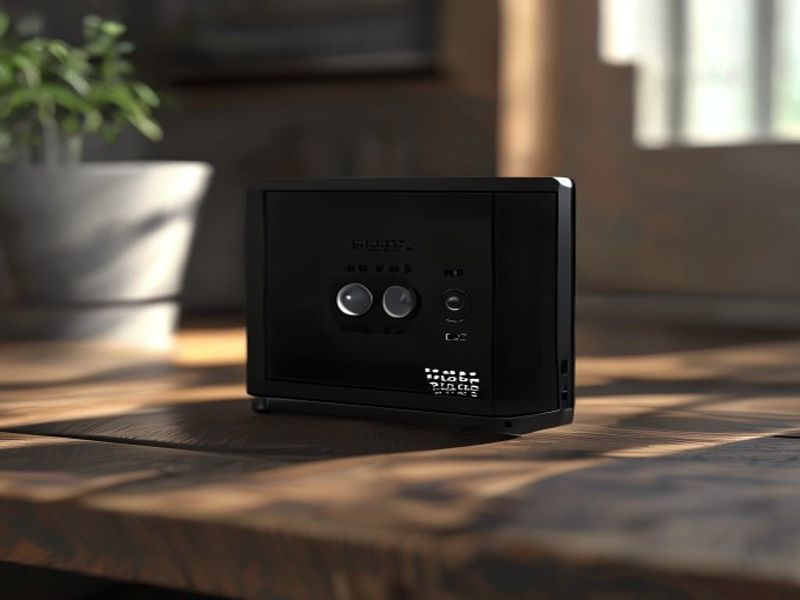
Living cable-free starts with a fairly simple setup. The primary transmitter (which looks like a slightly bulky smoke detector) mounts on the ceiling of a room such as a home office. Currently, not every device has a built-in RF receiver, so smartphones and tablets need specialized cases, and wireless mice and keyboards need a tiny snap-on receiver module.
Once it is running, the benefits are hard to ignore:
- The End of Battery Anxiety: A phone may rarely need to be plugged into a wall. Whether it's sitting on the desk, in your hand while you pace the room, or resting on the couch, the battery can stay topped up throughout the day.
- A Truly Clean Setup: The desk can finally be free of cables. No more routing charging wires behind the monitor or fishing for a dropped USB-C cable under the desk. Keyboards, mice, and noise-canceling headphones just work.
- Smart Home Synergy: The most underrated aspect is how this affects low-power smart home gadgets. Battery-operated temperature sensors and small smart displays within range may never need their batteries changed again. They just pull ambient power from the room.
What Are the Limitations of Room-Scale Wireless Power?
It's not all sci-fi perfection. We are still in the early stages of widespread consumer adoption, and there are some clear limitations you need to understand before buying into the hype.
First, charging speeds are slow. We are talking trickle-charging speeds here, usually hovering around 2 to 5 watts depending on distance. If your phone is completely dead and you need to leave the house in 15 minutes, the room transmitter won't help you much. You'll still need a traditional fast charger for emergencies. This tech is designed to maintain a charge over long periods, not rapidly refill a dead battery.
Second is the line-of-sight requirement. While the RF waves can bounce off walls to some extent, the most efficient charging happens when the transmitter has a clear path to the device. A phone buried at the bottom of a backpack isn't getting charged.
Finally, there's the compatibility hurdle. Slapping receiver cases on everything is annoying. The real magic will happen when manufacturers start embedding these tiny RF receiver chips directly into smartphones, laptops, and wearables by default. We are seeing early signs of this in late-2026 flagship models, but it will take a few more years for it to become ubiquitous.
Is Room-Scale Wireless Power Worth It?
If you are a tech enthusiast who hates cable clutter and constantly forgets to charge your peripherals, absolutely. The sheer convenience of setting your devices down anywhere in the room and knowing they will be charged when you pick them up is incredibly liberating. It changes your psychological relationship with batteries.
We are watching the death of the charging cable happen in real-time. It might start as a slow trickle charge in a home office, but in a few years, ambient wireless power will likely be as common and invisible as Wi-Fi.